

The Five Faces of Queen Victoria
By Justin Robinson, Historian for The London Mint Office
Queen Victoria’s reign (1837–1901) spanned more than six decades during a period of extraordinary political, industrial and cultural change for Britain. As the second-longest-reigning monarch in British history, coins bearing her image became instantly identifiable symbols of stability and authority throughout the Empire over which she reigned.
During her lifetime, five official portraits of Queen Victoria appeared on UK coins, and these enable us to consider not only how the Queen was perceived throughout her reign, but also how artistic tastes evolved during Victorian Britain. Together, these portraits form a remarkable visual timeline of the monarch and the era which bore her name.
The Young Head (1838–1887)
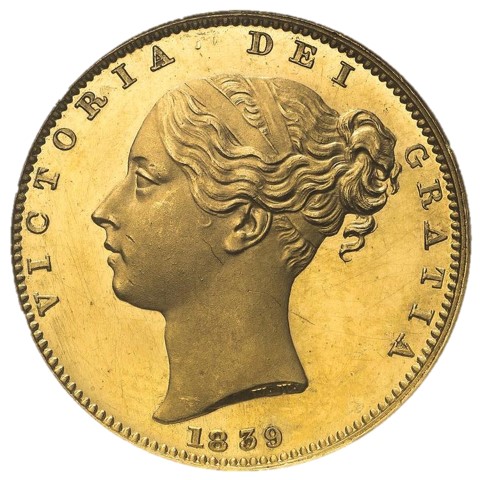
The first portrait of Queen Victoria to appear on circulating British coins was designed by the mint’s Chief Engraver, William Wyon (1795-1851). The Young Head portrait debuted shortly after her accession and presented the eighteen-year-old monarch in classical profile, wearing her hair in a simple bun tied with a ribbon. The design drew heavily on ancient Roman and Greek portraiture, emphasising elegance and youthful authority rather than regal grandeur.
Wyon’s work was widely praised for its delicacy, nobility and idealised beauty. The portrait conveyed a sense of optimism at the start of a new reign following the political turbulence of earlier decades. The Queen later congratulated Wyon for representing her so favourably, and the portrait remained on gold and silver coinage for 49 years, more than three decades after the engraver’s death. His initials (WW) appear on her truncated neck.
The Gothic Head (1847-1887)
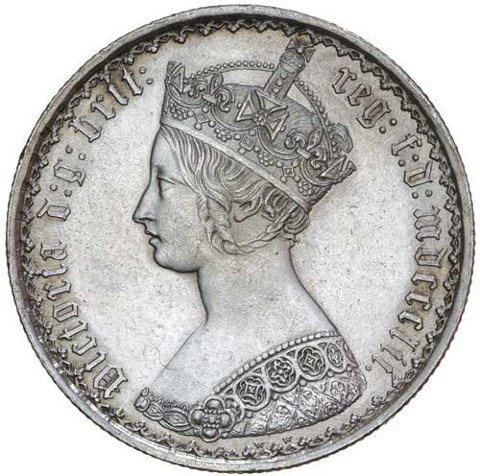
Although the Young Head dominated circulating coinage for decades, William Wyon created a special artistic portrait for the silver crown. The Gothic style, which reflected the chivalry, honour and romance of the medieval age, had become hugely popular in Victorian society and influenced the design of buildings, clothing, furniture, art and literature. Wyon depicted the Queen with an ornate crown over her loosely braided hair, which was the first time in over two centuries that a monarch had worn a crown on a British coin. The Queen’s richly embroidered dress featured roses, thistles and shamrocks, the national flora of England, Scotland and Ireland. Wyon’s initials can be found to the right of the portrait.
Wyon’s Gothic Head was well received when the crown was issued in 1849, and two years later, it was also used on Britain’s first decimal coin, the silver two-shilling (florin), worth one tenth of a pound. The first florin, struck in 1849, scandalised Victorian society because it omitted the letters D.G (By the grace of God) and F.D (Defender of the Faith) from its inscription. This was swiftly corrected in 1851, and the beautiful Gothic Head continued to appear on the florin until 1887.
The Bun Head (1860-1894)
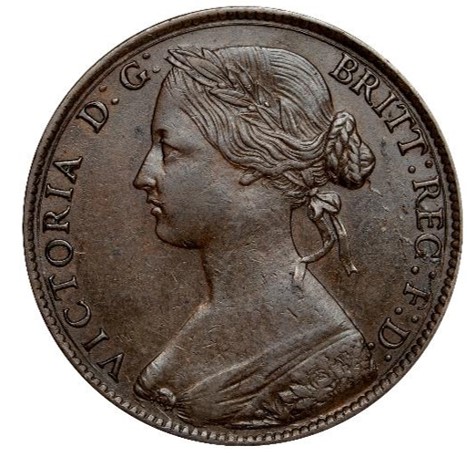
In 1860, the mint replaced the copper in its coins with a new bronze alloy comprising copper, tin and zinc. This produced farthings, halfpennies and pennies that were more durable, lighter and cheaper than solid copper. The decision was made to have a new portrait of the Queen on these coins, and the mint’s new Chief Engraver, Leonard Charles Wyon (1826-1891), was invited to follow in his father’s footsteps and create a new portrait. It quickly became known as the Bun Head because the Queen’s hair was drawn back into a plaited bun and tied with a ribbon at the nape.
Considering the design was only used for the lowest value coins, Leonard Wyon’s portrait was astonishingly intricate. The Queen wore a wreath of laurels in her hair, a circular brooch on her bodice, and a mantle around her shoulders adorned with a rose, thistle and shamrock. The design bridged the gap between the youthful optimism of the early Victorian era and the more solemn imagery that would follow in later decades.
The Jubilee Head (1887–1893)
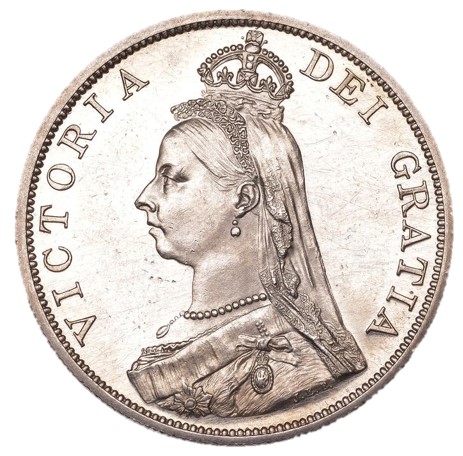
When Queen Victoria celebrated her Golden Jubilee in 1887, the mint celebrated by issuing a new portrait of the monarch on silver and gold coins. Designed by sculptor Joseph Edgar Boehm (1834-1890), the Jubilee Head depicted the 68-year-old monarch wearing a small crown and mourning veil along with a pearl necklace and earrings. The artist’s initials (JEB) can be found on the shoulder.
However, the public failed to warm to the new portrait, and critics complained that Boehm’s depiction of the stern-looking grandmother lacked the regal bearing of a monarch who had reigned for half a century. They also ridiculed the crown, which appeared awkwardly balanced and was almost comical in appearance. The design lasted only six years before being replaced with a new portrait in 1893.
Despite the controversy, Boehm’s portrait marked an important turning point in coin portraiture - it signalled a shift away from the classical idealisation of the past towards a more realistic portrayal of an ageing monarch whose authority was grounded in longevity and experience.
The Old/Veiled Head (1893–1901)
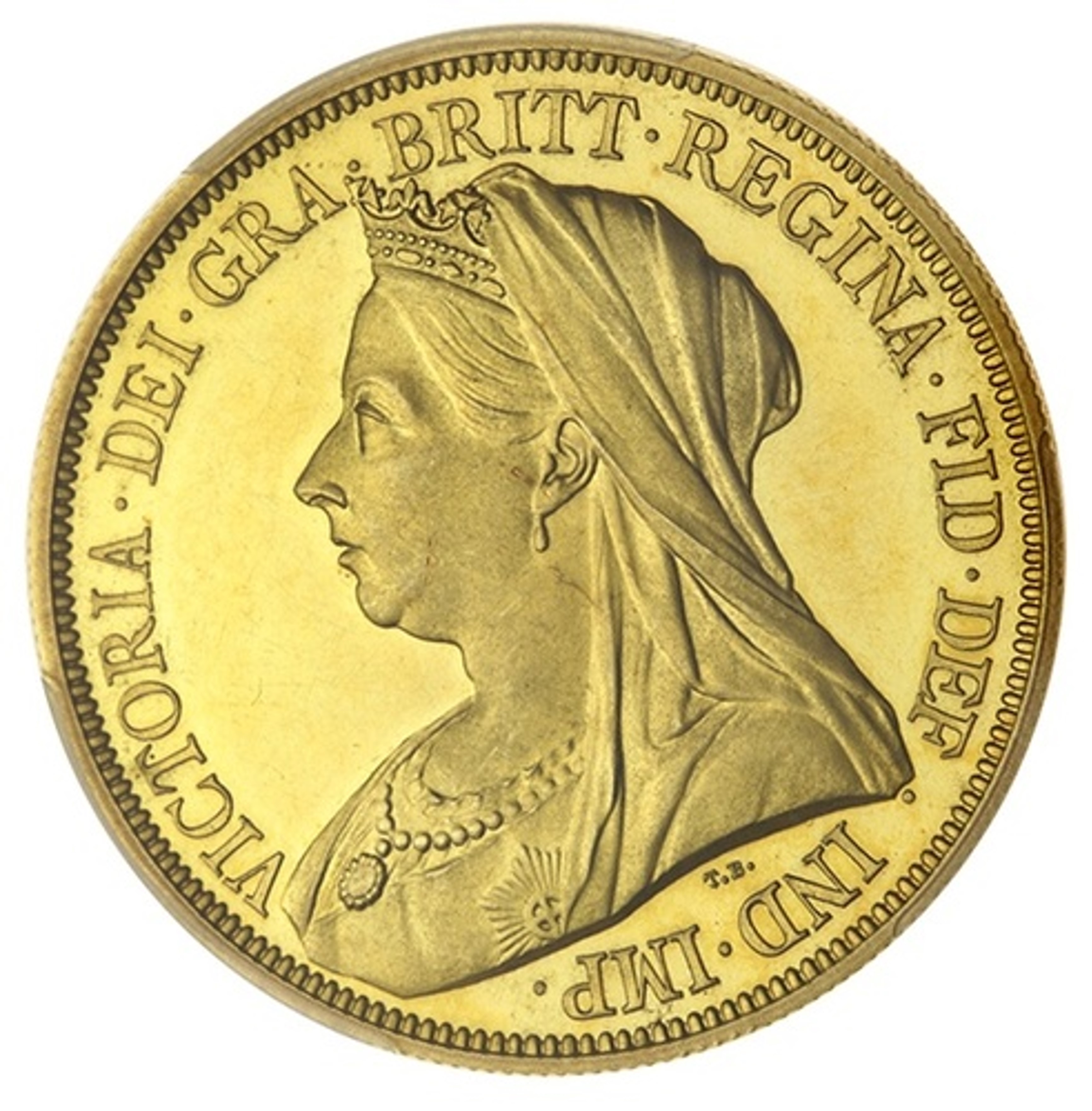
Queen Victoria’s final coin portrait, issued in her lifetime, was designed by Thomas Brock (1847 – 1922) and appeared on all bronze, silver and gold coinage struck between 1893 and 1901. He depicted the Queen wearing a lace mourning veil and a necklace that included the 22.48 carat Lahore Diamond. Instead of the small crown that had provoked such criticism of the previous design, she wore an elegant tiara.
Brock’s portrait of the 74-year-old Queen was popular with the public, who praised it for giving their monarch a regal, stately and dignified bearing. His initials (TB) appear below the Queen’s shoulder. Coins bearing his portrait of Queen Victoria were struck until she died in 1901 and remain among the most admired examples of British numismatic art. The design’s success can be attributed to the way Brock skilfully expressed not only her regal authority, but also her personal endurance through bereavement and change.
A Chronology in Coins
Today, 125 years after her death, Queen Victoria’s five coin portraits continue to fascinate collectors and historians alike. They chart the transformation of a teenage queen into a majestic empress, an evolution that reflects the extraordinary changes witnessed during the Victorian era.
The youthful elegance of Wyon’s Young Head reflects the optimism of early Victorian Britain; the Gothic Head displays the romantic artistic style of the period, while the Bun Head demonstrates the practical impact of technological innovation on coin design. Then the Jubilee Head sees the introduction of realism into coin portraiture, and, finally, the Old/Veiled Head captures the experience of a monarch who reigned over a quarter of the world’s population. In gold, silver and bronze, the changing faces of Queen Victoria on her coinage have left us a visual legacy that still resonates with collectors today.
How many portraits of Queen Victoria do you have in your collection?