

National Coin Flip Day - 1st June
National Coin Flip Day, celebrated annually on 1st June, is one of those wonderfully quirky observances that combines history, tradition and a touch of fun. In 2026, the special day falls on a Monday, offering us the perfect excuse to revisit one of humanity’s oldest decision-making rituals: the humble coin toss.
Dinner or takeaway?
Who goes first?
Stay or go?
Red or black?
Brave choice or safe bet?
For centuries, the coin toss has stepped in to make decisions when humans could not. For most people, flipping a coin is simply a quick way to settle an argument and choose between two options. But behind that brief moment when a coin spins through the air lies a surprisingly rich story stretching back more than two thousand years.
The Ancient Origins of the Coin Toss
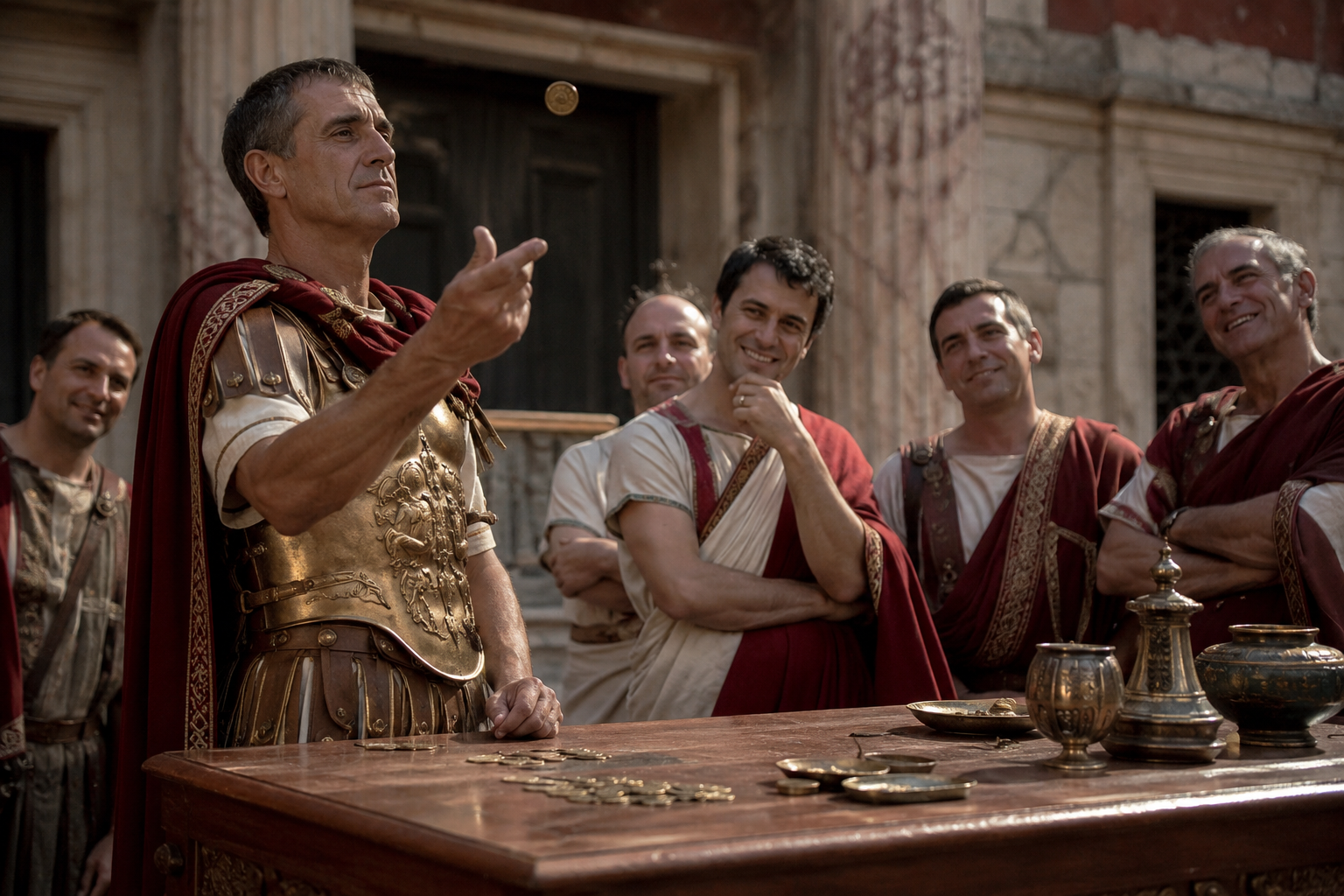
The practice of deciding outcomes by flipping a coin dates back to the ancient world. Historians often connect the tradition to Julius Caesar and the Roman Empire, where coins commonly featured the emperor’s portrait on one side. Romans referred to the game as navia aut caput, meaning “ship or head”, because some Roman coins displayed a ship on one side and a portrait on the other.
According to tradition, Caesar himself is said to have favoured the outcome featuring his own image. Whether entirely factual or embellished through the centuries, the story captures an important truth about coinage in the ancient world. Coins represented authority, legitimacy and power. To place a decision in the hands of a coin was, in many ways, to place it in the hands of fate itself.
Long before digital randomisers and smartphone apps, the coin toss provided something elegantly simple: a perfectly balanced choice. Two sides, equal odds, one outcome. That simplicity is precisely why the tradition has endured for centuries. One quick flip, one dramatic spin, and suddenly fate takes the starring role.
A Game of Chance
Britain has its own long association with coin flipping and games of chance. Medieval taverns often saw wagers settled with a tossed coin, while soldiers reputedly used coin flips to settle disputes or determine duties. By the Victorian era, tossing a coin had become embedded in British sporting culture.
Today, many sporting occasions still begin with a coin toss. Cricket captains meet before the opening ball, and football referees determine ends and kick-off decisions with a flip of a coin. Even globally watched events such as the Super Bowl continue the tradition in front of millions of viewers.
The Science Behind the Toss
There is something uniquely compelling about watching a coin spinning in the air. Perhaps it is because the result feels impartial. A spinning coin has no bias, no agenda and no emotion. It offers pure probability in its simplest form: fifty–fifty.

Psychologists have long observed that people often discover what they truly want while the coin is still airborne. The split second before the coin lands can reveal hidden preferences and instincts. In that sense, the coin toss becomes less about chance and more about clarity.
Although coin flipping appears entirely random, mathematicians and physicists have spent years studying the mechanics of the toss itself.
A coin flip is influenced by force, rotation, air resistance and landing surface. Some researchers even argue that coin tosses are not perfectly fifty–fifty if the same starting conditions are repeated consistently. In controlled experiments, coins can display a slight tendency to land on the same side they started on.
Fortunately, for everyday decision-making, the difference is negligible. The beauty of the coin toss remains its universal perception of fairness, which is why the practice has been remarkably resilient across cultures and centuries.
Famous Tosses
Throughout history, coins have occasionally found themselves at the centre of major moments.
The city of Portland in Oregon received its name in 1843 because of a coin toss, and that coin is now proudly displayed in a museum in the city.

Brothers Orville and Wilbur Wright flipped a coin to decide who would make the first manned flight in 1903. Wilbur won the toss but damaged the aircraft during his attempt. Three days later, following repairs, Orville successfully flew into the history books.
Sometimes, a coin toss can have tragic consequences. In February 1959, the flip of a coin reportedly helped decide which member of a touring group would accompany Buddy Holly and J.P. Richardson on a charter flight. Guitarist Tommy Allsup lost the toss, and 17-year-old Richie Valens took the final seat on the plane. Tragically, it crashed shortly after take-off, killing everyone on board.
For collectors, stories like these add emotional depth to numismatics. Coins are tangible witnesses to history. Unlike paintings locked away in galleries, coins were designed to pass through ordinary hands and extraordinary events. This connection between history and human experience is precisely what makes coin collecting so endlessly rewarding.
Small Object, Big Story
National Coin Flip Day reminds us that even the smallest everyday objects can carry enormous historical and cultural importance.
A coin may be small enough to balance on a fingertip, yet it can tell powerful stories of empires, battles and monarchs, preserve artistic achievements, or help settle a difficult choice. Few objects in human history combine practicality, artistry and storytelling so effectively.
So, this 1st June, whether you are deciding what to have for lunch, settling a friendly debate or simply admiring the craftsmanship of the coin in your hand, take a moment to appreciate the extraordinary journey behind that spinning piece of metal.
Because every coin has two sides.
And every coin has a story.